Wednesday, May 23, 2018

advendure's Mt. Pinatubo in Zambales


Image result for Mount Pinatubo


Mt. Pinatubo in Zambales

Mount Pinatubo (SambalBakil nin PinatubuKapampanganBunduk/Bulkan ning Pinatubu, Bunduk ning Apu MalyariPangasinanPalandey/Bulkan na PinatubuIlokanoBantay PinatuboTagalogBundok/Bulkang Pinatubo) is an active stratovolcano in the Zambales Mountains, located on the tripoint boundary of the Philippine provinces of ZambalesTarlac and Pampanga, all in Central Luzon on the northern island of Luzon.[3][4] Its eruptive history was unknown to most before the pre-eruption volcanic activities of 1991, just before June. Pinatubo was heavily eroded, inconspicuous and obscured from view. It was covered with dense forests which supported a population of several thousand indigenous Aetas.
Pinatubo is most notorious for its VEI 6 eruption on June 15, 1991, the second-largest terrestrial eruption of the 20th century after the 1912 eruption of Novarupta in Alaska.[5] Complicating the eruption was the arrival of Typhoon Yunya, bringing a lethal messy mix of ash and rain to towns and cities surrounding the volcano. Predictions at the onset of the climactic eruption led to the evacuation of tens of thousands of people from the surrounding areas, saving many lives. Surrounding areas were severely damaged by pyroclastic surges, ash falls, and subsequently, by the flooding lahars caused by rainwater re-mobilizing earlier volcanic deposits. This caused extensive destruction to infrastructure and changed river systems for years after the eruption.[5][6]
The effects of the eruption were felt worldwide. It ejected roughly 10,000,000,000 tonnes (1.1×10¹⁰ short tons) or 10 km3 (2.4 cu mi) of magma, and 20,000,000 tonnes (22,000,000 short tons) of SO
2, bringing vast quantities of minerals and toxic metals to the surface environment. It injected more particulate into the stratosphere than any eruption since Krakatoa in 1883. Over the following months, the aerosols formed a global layer of sulfuric acid haze. Global temperatures dropped by about 0.5 °C (0.9 °F) in the years 1991–93,[7] and ozone depletion temporarily increased substantially.

adventure's Mt. Apo in Davao City


Mt. Apo in Davao City

Image result for Mount Apo

In the Philippines, Mt. Apo is the highest point with an elevation of 3144 Meters above sea level, making it the Grand Father of all Philippine Mountains and the dream mountain of every Filipino mountaineer.
Mount Apo is one of the must see and experience for every adventure tourist or backpacker who visits the country specially in the Davao Province where it lies.
Considered as the most technical and interesting trail because of its narrow and different type of  trail  with very lush vegetation and pristine jungle which you can see the canopy ecosystem and different species of Flora & Fauna.
Its trail starts at a small village call Baruring, Sibulan, Sta. Cruz, Davao del Sur which a back packer would pass a farm trail, jungle trail and boulders trail before reaching the summit covering a distance of 13.7 Km with elevaion gain of approximately 2,000 meters from the trail head.
Mostly used trail that is why it has the widest trail of them all which starts in then Kidapawan, North Cotabato. This trail offers a river trail , jungle trail and grassland assault upon reaching the summit. Although a little bit far  the covers approximately 19 Km ,the experience in trekking this trail is also challenging.

adventure's in Mt. Kalaon in Negros Island


Mt. Kalaon in Negros Island

Image result for Kanlaon

Kanlaon (HiligaynonBulkan sang KanlaonCebuanoBulkan sa KanlaonSpanishVolcán de Canlaon, Malaspina), also spelled as Kanla-on or sometimes Canlaon, is an active stratovolcano on the island of Negros, Philippines. It is the highest point in Negros, as well as the whole Visayas, with an elevation of 2,465 m (8,087 ft) above sea level.
The volcano straddles the provinces of Negros Occidental and Negros Oriental, approximately 30 km (19 mi) southeast of Bacolod, the capital and most populous city of Negros Occidental and of the whole island region. It is one of the active volcanoes in the Philippines and part of the Pacific Ring of Fire.

adventure's in Mayon Volcano in ALbay


Mayon Volcano in Albay


Image result for Mayon Volcano


Mayon, the most famous of the active volcanoes of the Philippines, is a perfect stratovolcano rising to 2462 m on Luzon Island. It erupts very frequently.


Mayon is the archetype of a symmetrical stratovolcano and one of the world most active ones. It has frequent eruptions producing pyroclastic flows, mud flows and ash falls that repeatedly triggered large-scale evacuations. Mayon's most violent eruption, in 1814, killed more than 1200 people and devastated several towns. 
the volcano rises 2462 m above the Albay Gulf and has very steep upper slopes averaging 35-40 degrees capped by a small summit crater. 
Historical records of eruptions date back to 1616 and range from strombolian to basaltic plinian, with cyclical activity beginning with basaltic eruptions, followed by longer term andesitic lava flows. Eruptions occur predominately from the central conduit and have also produced lava flows that travel far down the flanks. Pyroclastic flows and mudflows have commonly swept down many of the approximately 40 ravines that radiate from the summit and have often devastated populated lowland areas.

adventure's in Taal Volcano in Batangas

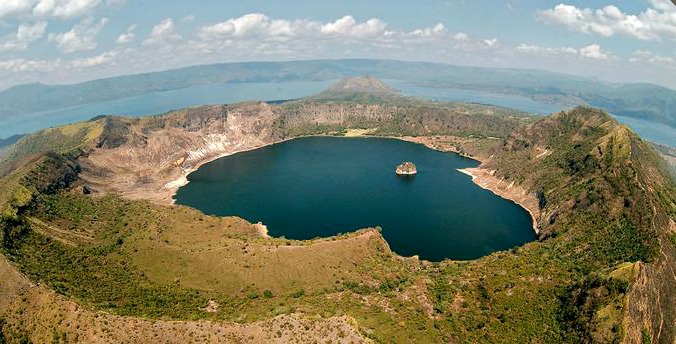
 Taal Volcano in Batangas

Image result for Taal Volcano

Taal Volcano is a complex volcano located on the island of Luzon in the Philippines.It is the second most active volcano in the Philippines with 33 historical eruptions. All of these eruptions are concentrated on Volcano Island, an island near the middle of Taal Lake. The lake partially fills Taal Caldera, which was formed by prehistoric eruptions between 140,000 and 5,380 BP. Viewed from Tagaytay Ridge, Taal Volcano and Lake presents one of the most picturesque and attractive views in the Philippines. It is located about 50 kilometres (31 miles) south of the capital of the country, the city of Manila.
The volcano had several violent eruptions in the past causing loss of life in the island and the populated areas surrounding the lake, with the death toll estimated at around 5,000 to 6,000. Because of its proximity to populated areas and its eruptive history, the volcano was designated a Decade Volcano, worthy of close study to prevent future natural disasters. All volcanoes of the Philippines are part of the Pacific Ring of Fire.

adventure's in Chocolate Hills in Bohol

Chocolate Hills in Bohol

Image result for Chocolate Hills
The Chocolate Hills are probably Bohol's most famous tourist attraction. They look like giant mole hills, or as some say, women's breasts, and remind us of the hills in a small child's drawing. Most people who first see pictures of this landscape can hardly believe that these hills are not a man-made artifact. However, this idea is quickly abandoned, as the effort would surely surpass the construction of the pyramids in Egypt. The chocolate hills consist of are no less than 1268 hills (some claim this to be the exact number). They are very uniform in shape and mostly between 30 and 50 meters high. They are covered with grass, which, at the end of the dry season, turns chocolate brown. From this color, the hills derive their name. At other times, the hills are green, and the association may be a bit difficult to make.

Legend has it that the hills came into existence when two giants threw stones and sand at each other in a fight that lasted for days. When they were finally exhausted, they made friends and left the island, but left behind the mess they made. For the more romantically inclined is the tale of Arogo, a young and very strong giant who fell in love with an ordinary mortal girl called Aloya. After she died, the giant Arogo cried bitterly. His tears then turned into hills, as a lasting proof of his grief.

However, up to this day, even geologists have not reached consensus on how they where formed. The most commonly accept theory is that they are the weathered formations of a kind of marine limestone on top of a impermeable layer of clay. If you climb the 214 steps to the top of the observation hill near the complex, you can read this explanation on a bronze plaque.

Tuesday, May 15, 2018

adventure's in Buntot palos Falls, Laguna


Buntot Palos Falls in Laguna


Buntot Palos Falls, located deep into the forests of the rugged Sierra Madre mountain range in the town of Pangil, Laguna is one of the several majestic waterfalls of the province. Also known as "Hidden Falls" it is in really, hidden away from civilization, requiring about two to three hours of hike into the rocky and mud pit-riddled trails and cutting into the slopes of Mt. Bikay. All the effort though is well rewarded with the sights and sounds of a grand cascade of falling water from a rocky precipice into a rugged collection of huge rocks and a wide and deep catch basin, perfect for swimming and of course, snapping photos.

According to Pinoy Mountaineer and my own observations, here are the specs for the hike to Mt. Bikay and Buntot Palos Falls: Minor climb; Difficulty: 2/9; Days Required/Hours to Falls: I day/s-3 hours; Major jump-olf: Brgy. Balian, Pangil, Laguna; Alternative jump-off: Pangil River Eco-Park; Features: River and Waterfall, views of Laguna de Bay and Rizal; LL: 14.4.1554 N,121.49;4° E; Height: 8o meters
http://thenovicetrekker.blogspot.com/2017/09/mt-bikay-337-masl-and-buntot-palos.html
jayson fabian your bloggers Adventures in Buntot Falls